Pose Space
An interactive visualization tool for analyzing yoga sequences through linear algebra and vector space geometry. Models each pose as a vector in high-dimensional joint-mobility space, comparing how different traditions navigate this space.
visit site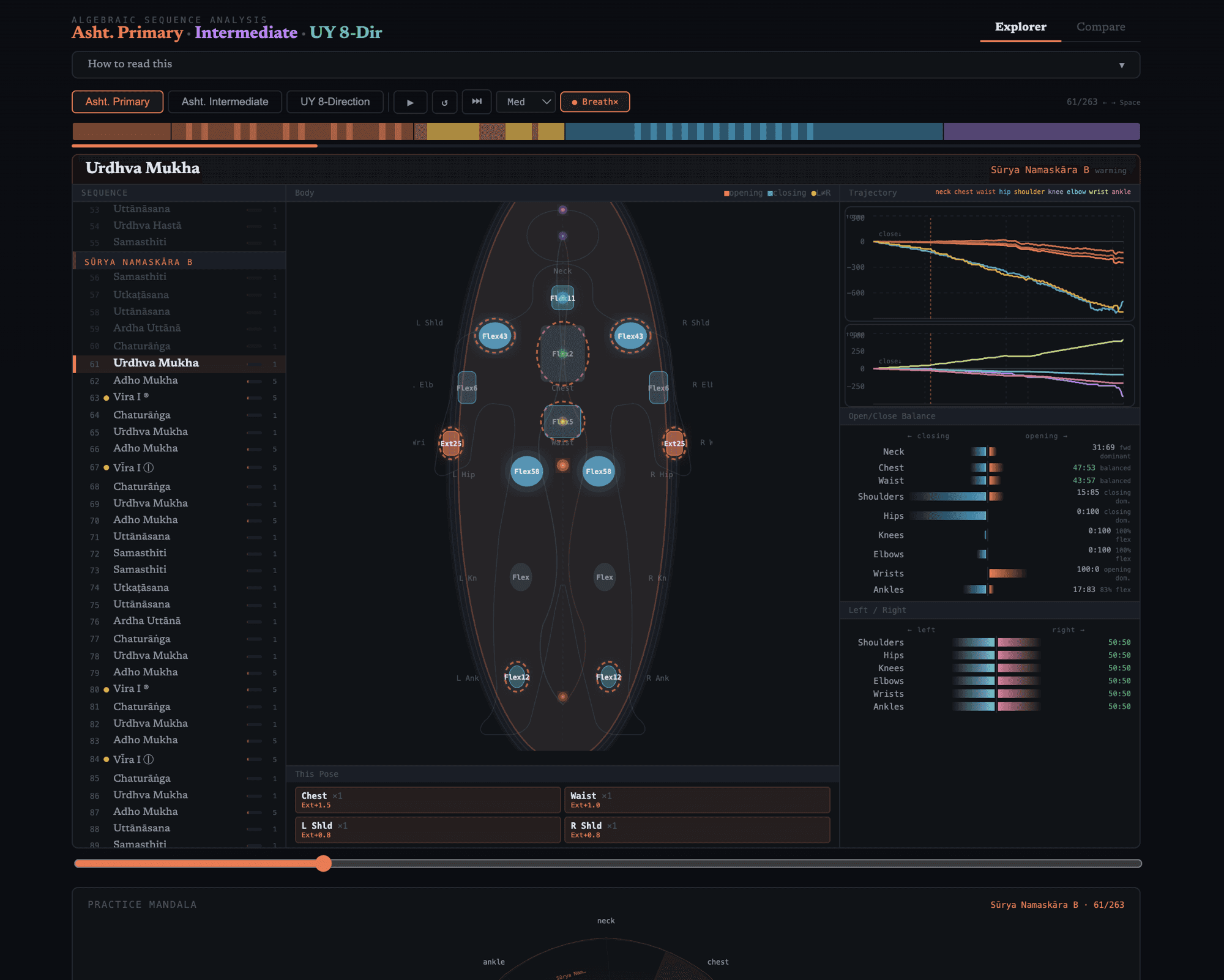
Yoga Teaching
After completing 300HR Universal Yoga Teacher Training under Andrey Lappa (2026), I wanted to quantify just how balanced his sequences were compared to others. His systematic approach to mobility and sequencing — combined with my background in mathematics — naturally led me to Pose Space: applying linear algebra and vector space geometry to analyze the structures underlying different yoga traditions.
Pose Space models yoga sequences as paths through high-dimensional joint-mobility space. Each pose becomes a vector spanning 14 joint regions — neck, waist, L/R shoulder, elbow, wrist, hip, knee, and ankle — with sign conventions distinguishing opening (+1) from closing (−1) movements.
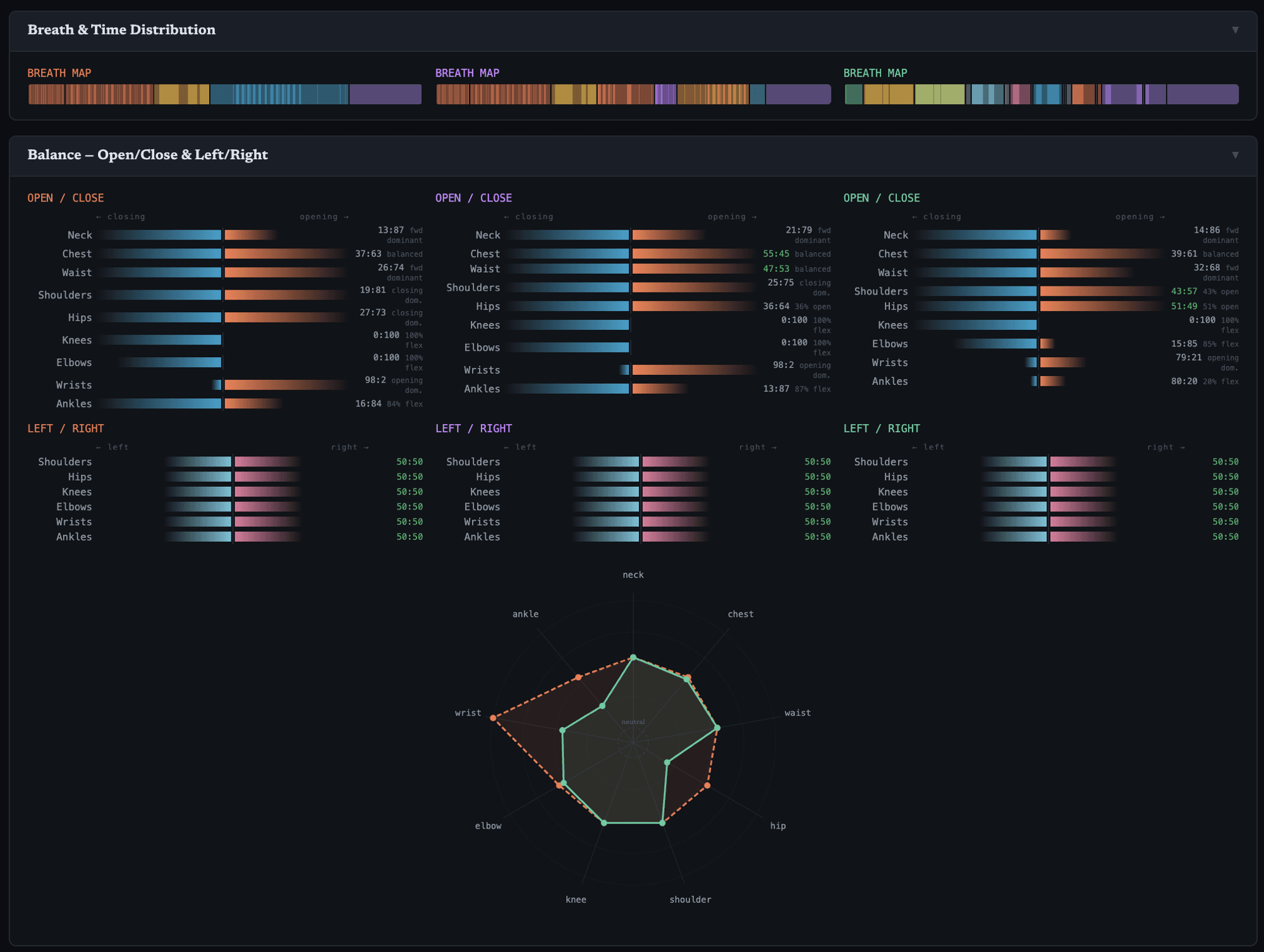
The cumulative state vector tracks the sequence's aggregate effect on each joint as you move through the practice. Balance is measured as its L₂ norm — a perfectly balanced sequence returns to the origin.
Sequence similarity is computed via cosine similarity, Shannon entropy measures how evenly a sequence distributes effort across all joint-directions, and PCA projections reduce the 72-dimensional paths to 2D for visualization.
The tool compares three sequences: Ashtanga Primary Series (Yoga Chikitsa), Ashtanga Intermediate Series (Nadi Shodhana), and Andrey Lappa's Universal Yoga 8-Directional Cross. Visualizations include body heatmaps, cumulative trajectories, practice mandalas, PCA projections, sequence fingerprints, and Panca Kosha five-sheath mappings.

The analytical framework draws on Neo-Riemannian music theory (Lewin, Cohn, Tymoczko) — a group-theoretic approach to analyzing sequential transformations in tonal space, here adapted for movement through joint-mobility space.
Yoga Teaching